
CE‑Provider Style
A structured, competency‑based curriculum designed to strengthen professional practice in addiction recovery and trauma‑informed intervention.

Coaching‑Oriented Clinical Hybrid
Learn practical, trauma‑informed coaching strategies that support client stabilization, behavior change, and long‑term recovery.

Behavioral Health Focus
Participants develop evidence‑based skills in emotional regulation, cognitive restructuring, and trauma‑responsive communication to enhance recovery outcomes.
Provided by NCOei & COREPSO
“This course is submitted for NAADAC approval”
About the Course
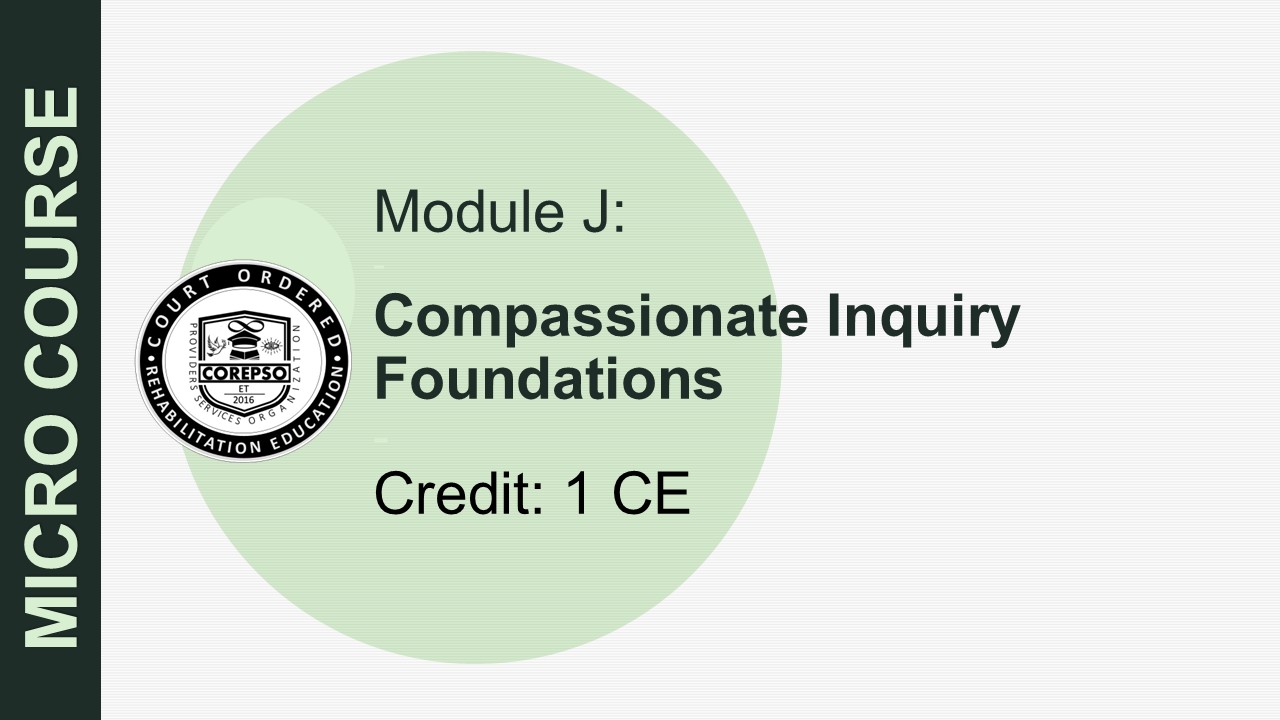
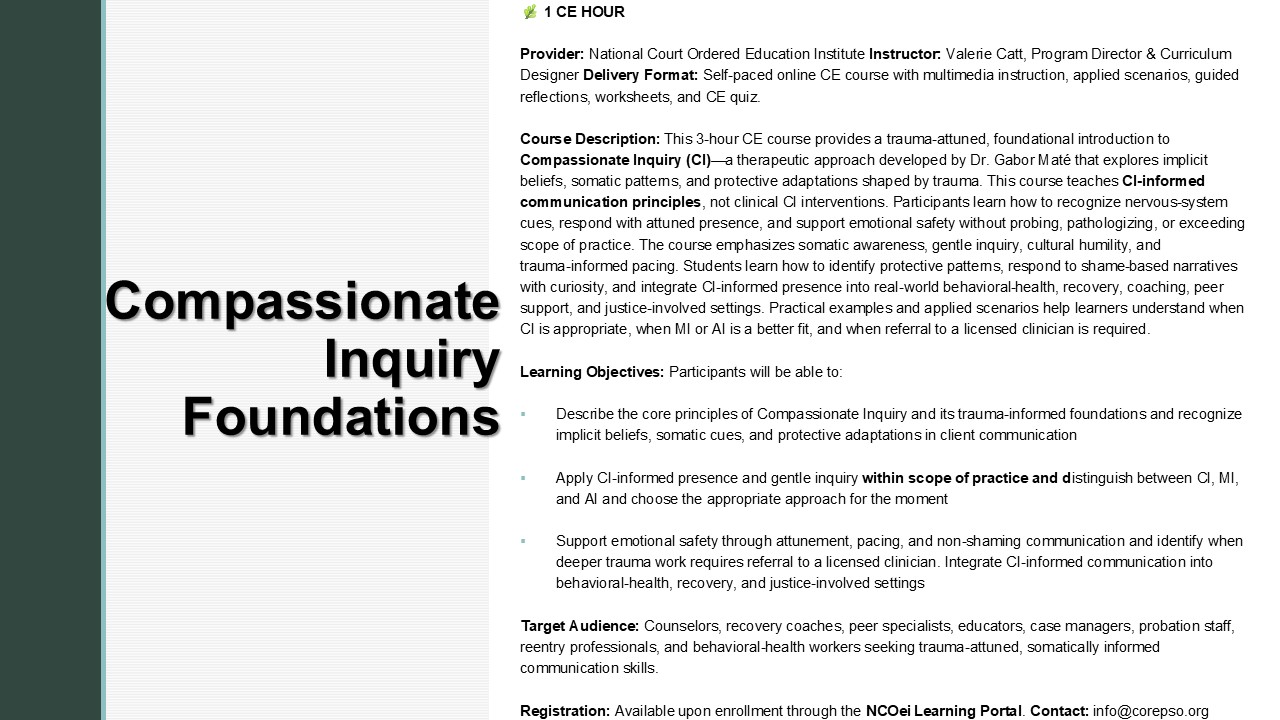
🌿 Course Overview: 1 CE Hour Grounded in trauma‑informed practice, this foundational 1‑CE course introduces helping professionals to Compassionate Inquiry (CI)—a trauma‑attuned, somatically informed approach that helps uncover implicit beliefs, protective adaptations, and nervous‑system patterns shaping client behavior. Participants learn CI‑informed presence, attunement, gentle inquiry, and scope‑appropriate strategies for supporting emotional safety without probing, pathologizing, or exceeding professional boundaries. Through concise multimedia instruction, applied examples, and structured practice, learners gain practical tools for recognizing somatic cues, responding to shame‑based narratives with curiosity, and supporting clients in moments of dysregulation or protective activation. The course emphasizes ethical boundaries, cultural humility, trauma‑informed pacing, and communication strategies that strengthen rapport across behavioral health, coaching, recovery, peer support, and justice‑involved settings. 🎯 Learning Objectives (NAADAC Aligned) By the end of this 1‑CE course, participants will be able to: • Describe the core principles and trauma‑informed foundations of Compassionate Inquiry • Recognize implicit beliefs, somatic cues, and protective adaptations in client communication • Apply CI‑informed presence, attunement, and gentle inquiry within scope of practice • Distinguish CI from MI and AI and choose the appropriate approach for the moment • Support emotional safety through pacing, curiosity, and non‑shaming communication • Demonstrate understanding of course concepts through applied activities and a CE quiz assessing comprehension and integration

Who This Course Is For
Courts, clinicians, coaches, and self‑paced learners all want to see themselves reflected. Examples: Individuals seeking trauma-informed addiction education; Professionals earning CE credits; /Court-referred participants needing structured support; Coaches wanting evidence‑aligned tools

What You Will Learn
This course is where you gain clinical competencies. Examples: Trauma‑informed frameworks; Emotional regulation strategies; Cognitive patterns & behavior change; Recovery‑oriented communication; Applied practice through reflection & scenarios

Course Includes
1 CE hours - 12 lessons Coaching videos - Quizzes Handouts - Discussion prompt Certificate of completion

Why This Program Works
The curriculum is grounded in established behavioral health models, combining psychoeducation, reflective practice, and skill‑building. Participants learn how trauma shapes cognition and behavior, and they apply these insights through guided exercises, journaling, and real‑world scenarios that reinforce long‑term change.

Meet Your Instructor
Valerie Catt Joglar, M.A., is a trauma‑informed educator and program director with extensive experience developing structured learning pathways for addiction recovery and emotional regulation. Her graduate work in psychology and health coaching informs her approach to creating safe, accessible, and clinically grounded educational programs for diverse populations, including court‑referred learners.

How to Enroll Now
Click “Enroll Now.” You’ll receive immediate access to the Module and all course materials. Create your student account. This allows you to track progress, complete lessons, and download your certificate. Begin your first lesson. Start at your own pace. Your coach and counselor will guide you through the next steps.

Course Curriculum
-
-
🌟 Module J: Compassionate Inquiry Foundations (NAADAC Aligned) Free preview
-
📥Downloadable Trifecta Curriculum Free preview
-
-
-
(Included in full purchase)
Lesson 1 — Video/Article: Listen Beneath Words: Compassionate Inquiry Foundations
-
(Included in full purchase)
Lesson 2 — Comprehension Quiz: Understanding Compassionate Inquiry
-
(Included in full purchase)
Lesson 3 — Download: Justice‑Involved Client Overview Sheet
-
(Included in full purchase)
Lesson 4 — Live Group Discussion: Compassionate Inquiry Foundations: Presence, Patterns & Somatic Awareness
-
(Included in full purchase)
-
-
(Included in full purchase)
Lesson 5 — Video/Article: Speak Safety: Attunement 101: Read the Body, Build Safety
-
(Included in full purchase)
Lesson 6 — Comprehension Quiz: Attunement, Presence & Somatic Tracking
-
(Included in full purchase)
Lesson 7 — Download: Somatic Awareness Worksheet
-
(Included in full purchase)
Lesson 8 — Live Group Discussion: Trauma‑Informed, Culturally Responsive Communication
-
(Included in full purchase)
-
-
(Included in full purchase)
Lesson 9 — Video/Article: Choose Safely: CI, MI, or AI?
-
(Included in full purchase)
Lesson 10 — Comprehension Quiz: CI vs MI vs AI and Choosing the Right Lens
-
(Included in full purchase)
Lesson 11 — Download: The CI Scope & Safety Checklist
-
(Included in full purchase)
Lesson 12 Activity: CI vs MI vs AI — Applied Lens Selection Scenarios
-
(Included in full purchase)
-
-
(Included in full purchase)
🌟 Module J Completion Message
-
(Included in full purchase)
⭐ NAADAC‑Compliant Post‑Course Evaluation Form
-
(Included in full purchase)
Start Your Transformation, Satisfy CE Requirements
Enroll today to begin your journey towards healing and personal growth.
$20.00
FAQ
⭐ Frequently Asked Questions How long do I have to complete the course? You can complete the module at your own pace. Most learners finish within 1–2 days, but you have full access for the duration of your program requirements. Is this course accepted for court or probation requirements? Yes. This program is designed to meet court‑ordered education standards and includes documentation, progress tracking, and a certificate of completion. Do I earn Continuing Education (CE) credits? Yes. This module provides Continuing Education hours for professionals seeking trauma‑informed addiction training. Do I need any prior experience? No. The course is designed for beginners and professionals. All concepts are explained clearly and supported with examples, videos, and guided reflection. What is included in the course? You receive access to structured lessons, coaching videos, quizzes, journal prompts, downloadable materials, and a completion certificate. Is there support if I have questions? Yes. Your rehabilitation coach helps you stay on track, and your licensed clinical counselor oversees your evaluation and treatment plan. What happens after I enroll? You’ll receive immediate access to the Module, along with instructions for downloading your journal/logbook and connecting with your mental health team. Can I use a mobile device? Yes. The entire course is mobile‑friendly and can be completed on a phone, tablet, or computer. Will I receive a certificate? Yes. After completing all lessons and assessments, you’ll receive a downloadable certificate showing your CE hours and completion date.
Student Testimonials
Discover how our course is making a difference in the lives of our participants.
As a licensed clinician, I was genuinely impressed by how this course integrates spiritual language without crossing ethical boundaries. It gave me a framework to honor clients’ metaphors about energy and alignment while staying firmly grounded in trauma‑informed, evidence‑aligned practice. It’s rare to find training that respects both worlds so skillfully.
Texas

This course offered a fresh, much‑needed perspective on what it truly means to hold the clinical role. Instead of repeating the same old compliance‑based messaging, it reframed our responsibilities in a way that felt empowering, modern, and deeply aligned with real‑world client communication. I left with a clearer sense of purpose and professional identity.
New York
The lesson plan was incredibly detailed — every concept, example, and tool was explained so clearly that I never once felt lost. It answered questions I didn’t even know I had. This is one of the most thoughtfully structured CE courses I’ve taken.
California
One thing that really stood out to me is how many high‑quality titles COREPSO offers. The topics are current, relevant, and genuinely interesting — not the recycled material you see in most CE libraries. It’s clear that a lot of thought goes into staying ahead of emerging trends in behavioral health and trauma‑informed practice.
Nevada
As a licensed clinician, I was genuinely impressed by how this course integrates spiritual language without crossing ethical boundaries. It gave me a framework to honor clients’ metaphors about energy and alignment while staying firmly grounded in trauma‑informed, evidence‑aligned practice. It’s rare to find training that respects both worlds so skillfully.
Texas
One thing that really stood out to me is how many high‑quality titles COREPSO offers. The topics are current, relevant, and genuinely interesting — not the recycled material you see in most CE libraries. It’s clear that a lot of thought goes into staying ahead of emerging trends in behavioral health and trauma‑informed practice.
Nevada
This course offered a fresh, much‑needed perspective on what it truly means to hold the clinical role. Instead of repeating the same old compliance‑based messaging, it reframed our responsibilities in a way that felt empowering, modern, and deeply aligned with real‑world client communication. I left with a clearer sense of purpose and professional identity.
New York
The lesson plan was incredibly detailed — every concept, example, and tool was explained so clearly that I never once felt lost. It answered questions I didn’t even know I had. This is one of the most thoughtfully structured CE courses I’ve taken.
California

Terms of Use (NAADAC Aligned)
“By enrolling, you agree to COREPSO/NCOei’s Terms of Use, including our nondiscrimination, grievance, and no‑refund policies.”